Have you ever trained consistently, watched your bodyweight stay flat, and wondered whether anything was actually changing? Bodyweight lumps muscle, fat, and water into one number, so if you gain muscle while losing fat, the scale can barely move even as your body changes. That's where body measurements — the circumference of your arms, legs, and so on — come in.
Why bodyweight alone hides your progress
Your weight can easily swing 1–2kg in a single day depending on food and water. Muscle grows far more slowly than that, so reading muscle gain from your weight trend is close to impossible. With measurements, you can see changes like "same weight, but bigger arms and a smaller waist" in actual numbers.
How to measure consistently
Changes in size are small — a few millimeters to a few centimeters — so if your measuring conditions shift each time, you can't tell a real change from measurement error. Keeping these points consistent makes your records far more reliable:
- Same time of day: for example, right after waking up and using the bathroom. Avoid measuring right after a workout, when the pump temporarily makes muscles bigger
- Same spot: decide on your own reference, such as the thickest part of the upper arm or a set distance from the hip for the thigh
- Keep the tape level: a tilted tape reads long. Let it sit flat on the skin without squeezing or sagging
- Decide flexed or relaxed: for the upper arm, pick one and stick with it
- Measure both sides: arms, forearms, thighs, and calves often differ left to right, and measuring one side hides the imbalance
How often to measure
Measuring every day mostly shows day-to-day noise. Once every 2–4 weeks is plenty. And when you look back, judge by the trend over a few months rather than any single change.
Read them next to your training
Measurements are most useful when you view them alongside your training log. Seeing that "my arms started growing after I added more arm sets" or "my legs stalled the month I trained them less" connects what you did with what happened, which makes it much easier to decide what to do more of next.
Keep in mind that measurements include fat and water too. Waist and chest numbers also move with body fat, so checking them together with bodyweight and body fat percentage helps you avoid misreading them.
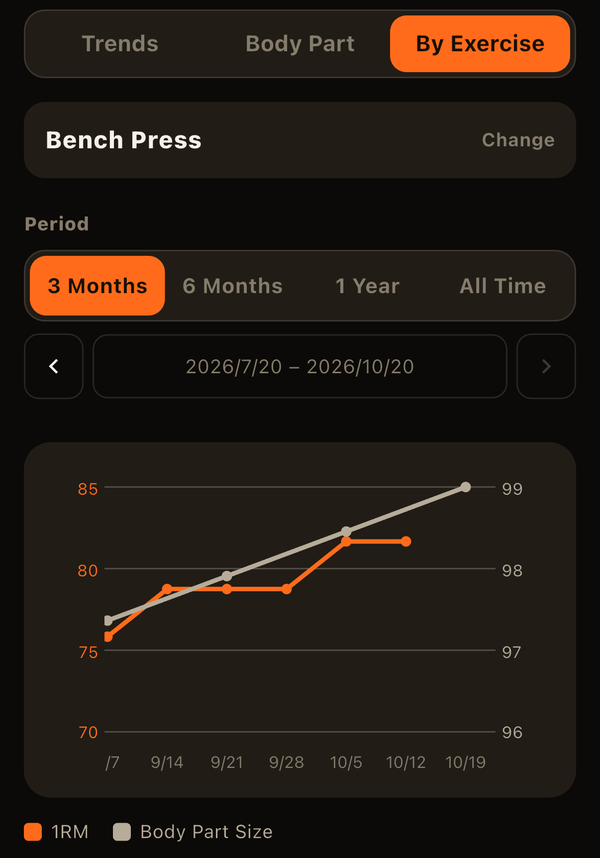
LiFTY's body stats let you record bodyweight and body fat percentage, plus neck, chest, shoulder width, waist, hips, and upper arm, forearm, thigh, and calf (each left and right). In the Analysis tab, you can overlay size trends on one chart with a body part's set count in the "Body Part" view, or with metrics like estimated 1RM in the "By Exercise" view (Using the Analysis Tab).
Related articles
- What Is Training Volume? How to Calculate It and Beat Plateaus
- How Many Sets per Muscle per Week? Finding Your Range
- Left/Right Strength Imbalances: Why Tracking Them Matters
LiFTY records 16 body stats, from bodyweight and body fat to left and right arm and leg sizes, and shows them next to your training log. No account needed to start right away.
Download on the App Store